Correlación de la calidad del agua y la comunidad parasitaria en Cyprinus carpio var. koi en Pachuca de Soto, Hidalgo, México
DOI:
https://doi.org/10.56926/repia.v5i1.145Palabras clave:
Centrocestus formosanus, índices ecológicos, índice de Pearson, monogeneo, zoonosisResumen
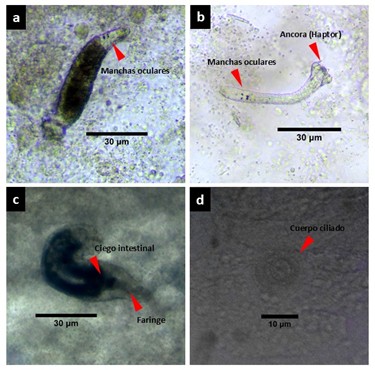
La producción de peces ornamentales representa un alto valor económico a nivel mundial; no obstante, diversos estresores ambientales pueden afectar el estado sanitario de los organismos. En este estudio se analizó el perfil parasitario de 18 carpas (Cyprinus carpio var. koi) y su correlación con la calidad del agua. Se observaron 223 parásitos y una prevalencia de 77.7 %, la comunidad parasitaria evidenció mayor presencia del monogeneo Gyrodactylus spp. (16.7 %) y el trematodo Centrocestus formosanus (66.6 %). La calidad del agua presentó valores elevados de nitratos (61.1 ± 20.2 mg L-1), alcalinidad (203.0 ± 124.0 mg L-1) y carbonatos (263.0 ± 89.8 mg L-1), así como correlaciones de compuestos nitrogenados con la prevalencia de monogeneos (r=0.6 a 1.0) y de C. formosanus con los nitratos (r=0.3) y el pH (r=0.4). La correlación entre los estresores ambientales y las cargas parasitarias en carpas de ornato puede resultar determinante para su gestión y comercialización.
Descargas
Citas
Acosta-Pérez, V.-J., Vega-Sánchez, V., Fernández-Martínez, T.-E., Zepeda-Velázquez, A.-P., Reyes-Rodríguez, N.-E., Ponce-Noguez, J.-B., Peláez-Acero, A., De-la-Rosa-Arana, J.-L., & Gómez-De-Anda, F.-R. (2022). Physicochemical water quality influence on the parasite biodiversity in juvenile tilapia (Oreochromis spp.) farmed at Valle del Mezquital in the Central-Eastern socioeconomic region of Mexico. Pathogens, 11(10), 1076. https://doi.org/10.3390/pathogens11101076
Adamba, S. W. K., Otachi, E. O., & Ong’ondo, G. O. (2020). Parasite communities of Oreochromis niloticus baringoensis (Trewavas, 1983) in relation to selected water quality parameters in the Springs of Lorwai Swamp and Lake Baringo, Kenya. Acta Parasitologica, 65(2), 441–451. https://doi.org/10.2478/s11686-020-00178-2
Ageng’o, F. O., Waruiru, R. M., Wanja, D. W., Nyaga, P. N., Hamisi, M. M., Khasake, C. N., Wainaina, J. M., Munde, B. M., Mbuthia, P. G., Kamuti, N. M., Ali, S. E., Tavornpanich, S., Keya, E. A., & Chadag, M. V. (2024). Relationship between water quality parameters and parasite infestation in farmed Oreochromis niloticus in selected Rift Valley Counties, Kenya. Aquaculture Research, 2024(1). https://doi.org/10.1155/2024/6139798
Aragón-Pech, R. A., Ruiz-Piña, H. A., Rodríguez-Vivas, R. I., Cuxim-Koyoc, A. D., & Reyes-Novelo, E. (2018). Prevalence, abundance and intensity of eggs and oocysts of gastrointestinal parasites in the opossum Didelphis virginiana Kerr, 1792 in Yucatan, Mexico. Helminthologia, 55(2), 119–126. https://doi.org/10.2478/helm-2018-0008
Arguedas Cortés, D., Dolz, G., J. Romero Zúñiga, J., E. Jiménez Rocha, A., & León Alán, D. (2009). Centrocestus formosanus (Opisthorchiida: Heterophyidae) como causa de muerte de alevines de tilapia gris Oreochromis niloticus (Perciforme: Cichlidae) en el Pacífico seco de Costa Rica. Revista de Biología Tropical, 58(4). https://doi.org/10.15517/rbt.v58i4.5423
Berman, J. J. (2018). Indispensable tips for fast and simple Big Data Analysis. In Principles and Practice of Big Data (pp. 231–257). Elsevier. https://doi.org/10.1016/B978-0-12-815609-4.00011-X
Bocek, A. (1991). Transporte de peces https://aurora.auburn.edu/bitstream/handle/11200/49657/Spanish Transporting Fish.pdf?sequence=3&isAllowed=y
Coelho Florindo, M., Tomas Jeronimo, G., Dordete Steckert, L., Acchile, M., Tavares Goncalves, E., Cardoso, L., & Laterca Martins, M. (2017). Protozoan parasites of freshwater ornamental fish. Latin American Journal of Aquatic Research, 45(5), 948–956. https://doi.org/10.3856/vol45-issue5-fulltext-10
Cruz García, F., Lara Reimers, E. A., García Hernández, A. R., Uresti Duran, D., Gonzales Fuentes, J. A., Encina Domínguez, J. A., & Uribe Salazar, Y. (2015). Estudio de plantas medicinales en el municipio de Pachuca de Soto Hidalgo, México. Polibotánica, 39. https://doi.org/10.18387/polibotanica.55.13
Elisafitri, M., Satyantini, W. H., Arief, M., & Sulmartiwi, L. (2021). Parasitic disease in Koi fish (Cyprinus carpio) in freshwater ponds with different densities in Sukabumi, West Java. IOP Conference Series: Earth and Environmental Science, 718(1), 012050. https://doi.org/10.1088/1755-1315/718/1/012050
Henrique, J., Vazquez, M., Siqueira, L., Cruz, M., da Silveira, L., & Ricardo, D. (2019). Technical and economic feasibility of food strategies in the hatchery of Cyprinus carpio (Cypriniformes, Cyprinidae) in a recirculating aquaculture system. Latin American Journal of Aquatic Research, 47(4), 626–637. https://doi.org/10.3856/vol47-issue4-fulltext-5
HIPRA. (2024). Icthiopathology Fish Necropsy Manual. https://d2557uuh057o9h.cloudfront.net/1f43b5a4-2879-4fc9-9084-8d6e7a4d5859/f38934be-6e32-4f25-9702-9fc5f91f936a/f38934be-6e32-4f25-9702-9fc5f91f936a_viewable_rendition__v.pdf
Hoshino, É. de M., Hoshino, M. D. F. G., & Tavares-Dias, M. (2018). Parasites of ornamental fish commercialized in Macapá, Amapá State (Brazil). Revista Brasileira de Parasitologia Veterinária, 27(1), 74–79. https://doi.org/10.1590/s1984-29612018002
Instituto Mexicano de Investigación en Pesca y Acuacultura Sustentable. (2018). Acuacultura-Peces de ornato. Gobierno de México. https://www.gob.mx/imipas/acciones-y-programas/acuacultura-peces-de-ornato#:~:text=En México se comercializan anualmente,federativas de la República Mexicana.
Instituto Nacional de Estadística y Geografía (INEGI). (2010). Principales resultados del Censo de Población y Vivienda 2020 Hidalgo.
Karal Marx, K., Rathipriya, A., Sundaray, J. K., & Muthu Abishag, M. (2020). Water Quality Management in aquaculture. In Broodstock management and fish seed production (pp. 119–134). CRC Press. https://doi.org/10.1201/9781003111689-13
Lavalle, C., Clarence, S., Khan, H., Shires, K., & Parrott, J. (2025). Current research and guidelines for euthanasia in laboratory fish with a focus on fathead minnows. Laboratory Animals, 59(3), 319–331. https://doi.org/10.1177/00236772241288146
Maftuch, M., Sanoesi, E., Farichin, I., Saputra, B. A., Ramdhani, L., Hidayati, S., Fitriyah, N., & Prihanto, A. A. (2018). Histopathology of gill, muscle, intestine, kidney, and liver on Myxobolus sp.-infected Koi carp (Cyprinus carpio). Journal of Parasitic Diseases, 42(1), 137–143. https://doi.org/10.1007/s12639-017-0955-x
Moreno, C. E. (2001). Métodos para medir la biodiversidad (M. y T. SEA (Ed.); M&T–Manual). M&T–Manuales y Tesis SEA vol. 1. Zaragoza.
Morris, T. C., van der Ploeg, J., Bih Awa, S., van der Lingen, C. D., & Reed, C. C. (2019). Parasite community structure as a predictor of host population structure: An example using Callorhinchus capensis. International Journal for Parasitology: Parasites and Wildlife, 8, 248–255. https://doi.org/10.1016/j.ijppaw.2019.03.007
Muthiah, M. (2014). Seeds and Live Fishes To and From Watershed Ponds (F. (p. 12). A. P. En N. Sangeeta & K. Nirmal (Eds.) (Ed.); En N. Sang). En N. Sangeeta & K. Nirmal (Eds.), Fisheries (p. 12). Allied Printers.
Ojwala, R. A., Otachi, E. O., & Kitaka, N. K. (2018). Effect of water quality on the parasite assemblages infecting Nile tilapia in selected fish farms in Nakuru County, Kenya. Parasitology Research, 117(11), 3459–3471. https://doi.org/10.1007/s00436-018-6042-0
Opiyo, M., Mziri, V., Musa, S., Kyule, D., Hinzano, S., Wainaina, M., Magondu, E., Werimo, K., & Ombwa, V. (2020). Fish disease management and biosecurity systems. Status of Aquaculture in Kenya, 97–126. https://www.researchgate.net/publication/351050775
Paopun, Y., Thanomchat, P., & Kronburee, N. (2024). Colocasia esculenta (L.) Schott (Wild Taro): Calcium Oxalate crystals in leaf and petiole using light microscopy, scanning electron microscopy and energy dispersive X-ray spectroscopy. The Journal of The Microscopy Society of Thailand, 37(1), 1–7. https://ph02.tci-thaijo.org/index.php/mmres/article/view/251482/170949
Paredes-Trujillo, A., Cano Rufino, L., & Hernández-Pérez, A. (2024). Parasites of veterinary importance of ornamental fish commercialized in Mexico. Veterinary Parasitology: Regional Studies and Reports, 56, 101134. https://doi.org/10.1016/j.vprsr.2024.101134
Pietsch, C., & Hirsch, P. (Eds.). (2015). Biology and Ecology of Carp. CRC Press. https://doi.org/10.1201/b18547
Pinto, H. A., Gonçalves, N. Q., López-Hernandez, D., Pulido-Murillo, E. A., & Melo, A. L. (2018). The life cycle of a zoonotic parasite reassessed: Experimental infection of Melanoides tuberculata (Mollusca: Thiaridae) with Centrocestus formosanus (Trematoda: Heterophyidae). PLOS ONE, 13(4), e0194161. https://doi.org/10.1371/journal.pone.0194161
Pinto, H. A., Mati, V. L. T., & Melo, A. L. (2014). Metacercarial Infection of Wild Nile Tilapia (Oreochromis niloticus) from Brazil. The Scientific World Journal, 2014, 1–7. https://doi.org/10.1155/2014/807492
Rebollar-Zamorano, M., Morales-Ubaldo, A. L., González-Alamilla, E. N., Ángeles-Rodríguez, A., Valladares-Carranza, B., Velásquez-Ordoñez, V., Rivero-Pérez, N., & Zaragoza-Bastida, A. (2020). Análisis epidemiológico retrospectivo de Distemper Canino en la ciudad de Pachuca de Soto , Estado de Hidalgo. Journal of the Selva Andina Animal Science, 7(1), 40–46.
Ribeiro, F. D. A. S., Preto, B. D. L., & Fernandes, J. B. K. (2009). Sistemas de criação para o acará-bandeira (Pterophyllum scalare). Acta Scientiarum. Animal Sciences, 30(4). https://doi.org/10.4025/actascianimsci.v30i4.685
Rivera Pérez, C., & Hernández Saavedra, N. Y. (2021). Compuestos bioactivos derivados de moluscos marinos. Recursos Naturales y Sociedad, 7(2), 61–84. https://doi.org/10.18846/renaysoc.2021.07.07.02.0005
Rodríguez-Gutiérrez, M., Olivares-Orozco, J. L., & Pineda-Escobar, M. E. (2025). Origen y diversidad genética de la carpa común (Cyprinus carpio). Ciencia Pesquera, 33(1), 29–50. https://doi.org/10.64106/cienciapesquera.v33i1.47
Saengsitthisak, B., Punyapornwithaya, V., Chaisri, W., Mektrirat, R., Bernard, J. K., & Pikulkaew, S. (2020). The current state of biosecurity and welfare of ornamental fish population in pet fish stores in Chiang Mai Province, Thailand. Veterinary Integrative Sciences, 19(2), 277–294. https://doi.org/10.12982/VIS.2021.025
Saint-Erne, N. (2019). Water Quality in Koi Practice - WSAVA 2019 Congress - VIN. World Small Animal Veterinary Association Congress Proceedings, 2019. 2019. https://www.vin.com/apputil/project/DefaultAdv1.aspx?pId=24437&SAId=-1&id=9382754
Sasanami, M., Hustedt, J., Alexander, N., Horstick, O., Bowman, L., Hii, J., Echaubard, P., Braack, L., & Overgaard, H. J. (2021). Does anthropogenic introduction of guppy fish (Poecilia reticulata) impact faunal species diversity and abundance in natural aquatic habitats? A systematic review protocol. Environmental Evidence, 10(1), 33. https://doi.org/10.1186/s13750-021-00248-6
Scholz, T. (2009). The introduction and dispersal of Centrocestus formosanus (Nishigori, 1924) (Digenea: Heterophyidae) in Mexico: A Review. The American Midland Naturalist, 143, 185–200. https://doi.org/https://doi.org/10.1674/0003-0031(2000)143[0185:TIADOC]2.0.CO;2
Secretaría de Salud. (2010). Norma Oficial Mexicana NOM-251-SSA1-2009, prácticas de higiene para el proceso de alimentos, bebidas o suplementos alimenticios. Diario Oficial de La Federación. https://www.dof.gob.mx/normasOficiales/4295/salud2a/salud2a.htm
Sepulveda, M. S., & Kinsella, J. M. (2013). Helminth collection and identification from wildlife. Journal of Visualized Experiments, 82. https://doi.org/10.3791/51000
Sermwatanakul, A. (2019). Capacitating the local farmers to enhance global marketing of Thailand’s national aquatic animal, the Siamese fighting fish. Fish for the People, 17(2), 42–48. http://repository.seafdec.org/bitstream/handle/20.500.12066/5516/Siamese-fighting-fish.pdf?sequence=1&isAllowed=y
Silva, J. O. S., Stabile, B. H. M., da Graça, R. J., Oliveira, A. V., & Takemoto, R. M. (2024). Ornamental fish mortality reveals an old parasite introduction: A case study of Koi carp and fish louse. Veterinary Parasitology: Regional Studies and Reports, 51, 101034. https://doi.org/10.1016/j.vprsr.2024.101034
Steckler, N. (2016). Koi Diseases and Treatments : 5 Most Common Pathogens and Their Treatments. Aquatic Medicine, 1309–1311.
Sumuduni, B. G. D., Munasinghe, D. H. N., & Arulkanthan, A. (2020). Investigation of complete life cycle and species identification of a digenean gill parasite Centrocestus sp. infesting Koi carp (Cyprinus carpio Linnaeus, 1758) using morphology and morphometric characters. Ceylon Journal of Science, 49(2), 185. https://doi.org/10.4038/cjs.v49i2.7739
Sumuduni, B., Munasinghe, D., & Arulkanthan, A. (2017). Survivability and Transmission rate of Centrocestus sp . Cercariae to early fingerlings of Koi carp (Cyprinus carpio) and letal number of parasites to fry with site preference of infection. Journal of Fisheries and Life Science, 35–39.
Vélez‐Hernández, E. M., Constantino‐Casas, F., García‐Márquez, L. J., & Osorio‐Sarabia, D. (1998). Gill lesions in common carp, Cyprinus carpio L., in Mexico due to the metacercariae of Centrocestus formosanus. Journal of Fish Diseases, 21(3), 229–232. https://doi.org/10.1046/j.1365-2761.1998.00091.x
Wilson, J. (2019). Parasites of the invasive tilapia Oreochromis mossambicus: evidence for co-introduction. Aquatic Invasions, 14(2), 332–349. https://doi.org/10.3391/ai.2019.14.2.11
Yanuhar, U., Musa, M., Evanuarini, H., Wuragil, D. K., & Permata, F. S. (2022). Water quality in Koi Fish (Cyprinus carpio) concrete ponds with filtration in Nglegok District, Blitar Regency. Universal Journal of Agricultural Research, 10(6), 814–820. https://doi.org/10.13189/ujar.2022.100619
Zamora-Roa, E., Castelán-Rosas, L. R., Vega Sánchez, V., Vega Sánchez, V., Icon, O., Cordero López, A. P., Gómez de Anda, F. R., & Acosta Pérez, V. J. O. (2025). Centrocestus formosanus (Heterophydae) infection in ornamental fish Cyprinus carpio var. koi (Cyprinidae): in Mexico center. Aquatic Animal Reports (AQAR), 1. https://doi.org/https://doi.org/10.5281/zenodo.15542999
Descargas
Publicado
Cómo citar
Número
Sección
Licencia
Derechos de autor 2026 Gisel Villaseñor-Reyes, Paulina Nájera-Alemán, Víctor-Johan Acosta-Pérez, Jaqueline Rabling-Olivera, Jaqueline González-Vázquez, Karla-Paola Ubilla-Paredes, Irene-Sofía Bell-Palacios, Fabián-Ricardo Gómez-de-Anda, Andrea-Paloma Zepeda-Velázquez

Esta obra está bajo una licencia internacional Creative Commons Atribución 4.0.
Los autores retienen sus derechos:
a. Los autores conservan los derechos de propiedad intelectual (copyright) de las obras publicadas, cediendole a la revista el derecho de primera publicación.
b. Los autores retienen sus derechos de marca y patente, y también sobre cualquier proceso o procedimiento descrito en el artículo.
c. Los autores retienen el derecho de compartir, copiar, distribuir, ejecutar y comunicar públicamente el artículo publicado en la REPIA (por ejemplo, colocarlo en un repositorio institucional o publicarlo en un libro), con un reconocimiento de su publicación inicial en la REPIA.
d. Los autores retienen el derecho a hacer una posterior publicación de su trabajo, de utilizar el artículo o cualquier parte de aquel (por ejemplo: una compilación de sus trabajos, notas para conferencias, tesis, o para un libro), siempre que indiquen la fuente de publicación (autores del trabajo, revista, volumen, número y fecha).