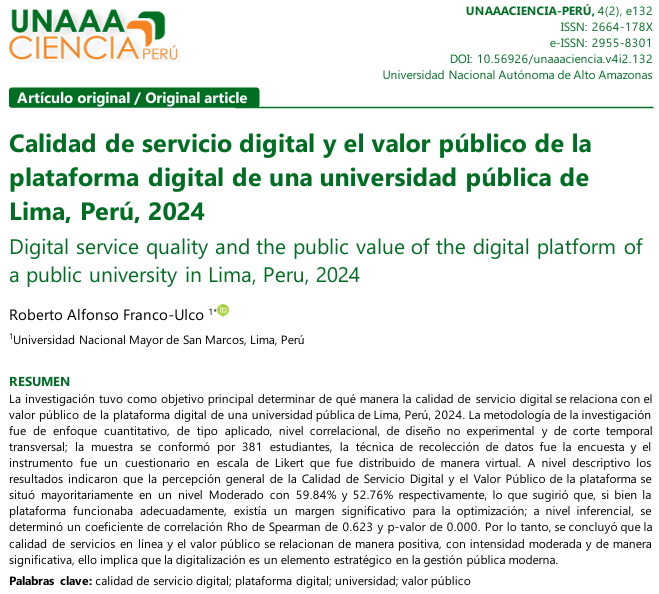
Digital service quality and the public value of the digital platform of a public university in Lima, Peru, 2024
DOI:
https://doi.org/10.56926/unaaaciencia.v4i2.132Keywords:
Digital service quality, public value, digital platform, universityAbstract
The main objective of this research was to determine how the quality of digital service relates to the public value of the digital platform of a public university in Lima, Peru, 2024. The research methodology was quantitative, applied, correlational, non-experimental, and cross-sectional. The sample consisted of 381 students, the data collection technique was a survey, and the instrument was a Likert-scale questionnaire that was distributed virtually. At a descriptive level, the results indicated that the general perception of the quality of digital service and the Public Value of the platform was mostly at a Moderate level with 59.84% and 52.76% respectively, which suggested that, although the platform functioned adequately, there was significant room for optimization. At an inferential level, a Spearman's Rho correlation coefficient of 0.623 and a p-value of 0.000 were determined. Therefore, it was concluded that online service quality and public value are positively related, with moderate intensity and significance, implying that digitalization is a strategic element in modern public management.
Downloads
References
Adubaa, D., & Mayowa Adebara, O. (2022). Online Platforms Used for Teaching and Learning during the COVID-19 Era: The Case of LIS Students in Delta State University, Abraka. The International Information & Library Review 54 (1), 17-31. doi:https://doi.org/10.1080/10572317.2020.1869903
Aljukhadar, M., Belisle, J., Dantas, D., Sénécal, S., & Titah, R. (2022). Measuring the service quality of governmental sites: Development and validation of the e-Government service quality (EGSQUAL) scale. Electronic Commerce Research and Applications Vol 55, 101182. doi: https://doi.org/10.1016/j.elerap.2022.101182
Alruwaie, M., El-Haddadeh, R., & Weerakkody, V. (2020). Citizens' continuous use of eGovernment services: The role of self-efficacy, outcome expectations and satisfaction. Government Information Quarterly 37 (3), 101485. doi: https://doi.org/10.1016/j.giq.2020.101485
Alshammary, F., & Alhalafawy, W. (2023). Digital Platforms and the Improvement of Learning Outcomes: Evidence Extracted from Meta-Analysis. Sustainability 15 (2), 1305. doi: https://doi.org/10.3390/su15021305
Benmohamed, N., Shen, J., & Vlahu-Gjorgievska, E. (2024). Public value creation through the use of open government data in Australian public sector: A quantitative study from employees' perspective. Government Information Quarterly 41 (2), 101930. doi: https://doi.org/10.1016/j.giq.2024.101930
Chan, F., Thong, J., Brown, S., & Venkatesh, V. (2025). Design characteristics and service experience with e-government services: A public value perspective. International Journal of Information Management 80, 102834. doi: https://doi.org/10.1016/j.ijinfomgt.2024.102834
Claros Vásquez, C. (2024). Calidad de servicio y satisfacción de los estudiantes en la Universidad Nacional de Barranca, 2023 (Tesis de Doctorado). Universidad Nacional José Faustino Sánchez Carrión. http://hdl.handle.net/20.500.14067/9388
Comisión Económica para América Latina y el Caribe. (2021). Enfoque de resultados y valor publico. https://repositorio.cepal.org/bitstream/handle/11362/46795/1/S2100039_es.pdf
Cruz Dallagnol, E., & Portulhak, H. (2025). Public value disclosure by Brazilian federal universities. The British Accounting Review, 101587. doi: https://doi.org/10.1016/j.bar.2025.101587
Galindo Domínguez, H. (2020). Estadistica para no estadisticos. Una guía básica sobre la metodología cuantitativa de trabajos academicos. 3 Ciencias.
Hemesath, S., & Tepe, M. (2024). Public value positions and design preferences toward AI-based chatbots in e-government. Evidence from a conjoint experiment with citizens and municipal front desk officers. Government Information Quarterly 41 (4), 101985. doi: https://doi.org/10.1016/j.giq.2024.101985
Hernández , R., & Mendoza , C. (2018). Metodología de la investigación:Las rutas cuantitativa, cualitativa y mixta. Mexico: Mc Graw Hill.
Huapaya, G., Sumire, R., Jarama, R., & Sumire, E. (2023). Calidad de Servicio y Satisfacción de Estudiantes Universitarios con la Educación Virtual en Tiempos de Pandemia. Encuentros: Revista de Ciencias Humanas, Teoría Social y Pensamiento Crítico N° 17, 250-275. doi: http://doi.org/10.5281/zenodo.7527667
Khan, S., Umer, R., Umer, S., & Naqvi, S. (2021). Antecedents of trust in using social media for E-government services: An empirical study in Pakistan. Technology in Society Vol 64, 101400. doi: https://doi.org/10.1016/j.techsoc.2020.101400
Kim, S. (2023). Quality of smart-work support service, perceived value and intention to continue smart-work: empirical evidence from Korea. Information Technology & People 36 (5), 2137-2160. doi: https://doi.org/10.1108/ITP-08-2020-0544
Li, Y., & Shang, H. (2020). Service quality, perceived value, and citizens’ continuous-use intention regarding e-government: Empirical evidence from China. Information & Management 57 (3), 103197. doi: https://doi.org/10.1016/j.im.2019.103197
Malacina, I., Karttunen , E., Jääskeläinen, A., Lintukangas, K., Heikkilä, J., & Kähkönen, A. (2022). Capturing the value creation in public procurement: A practice-based view. Journal of Purchasing and Supply Management 28 (2), 100745. doi: https://doi.org/10.1016/j.pursup.2021.100745
Nookhao, S., & Kiattisin, S. (2023). Achieving a successful e-government: Determinants of behavioral intention from Thai citizens’ perspective. Heliyon 9 (8), e18944. doi: https://doi.org/10.1016/j.heliyon.2023.e18944
Organización de las Naciones Unidas. (2022). E-Government Survey 2022 The Future of Digital Government. https://desapublications.un.org/sites/default/files/publications/2022-09/Web%20version%20E-Government%202022.pdf
Parasuraman, A., Zeithaml, V., & Berry, L. (2019). SERVQUAL: A Multiple-Item Scale for Measuring Consumer Perceptions of Service Quality. Simon and Schuster Publishing.
Paredes Romero, K. (2022). Procesos académicos virtuales en la satisfacción del servicio en estudiantes de la Universidad Nacional Intercultural de la Amazonia, 2022. Ciencia Latina Revista Científica Multidisciplinar 6 (4), 4989-5014. doi: https://doi.org/10.37811/cl_rcm.v6i4.2989
Sumi, R., & Kabir, G. (2021). Satisfaction of E-Learners with Electronic Learning Service Quality Using the SERVQUAL Model. Journal of Open Innovation: Technology, Market, and Complexity 7 (4), 227. doi: https://doi.org/10.3390/joitmc7040227
Valverde Iparraguirre, J. (2022). Modelo de gobierno digital basado en Cobit 2019 y el valor público en la Universidad Nacional de San Martín (Tesis Doctoral). Universidad Nacional de San Martín. http://hdl.handle.net/11458/4543
Xiong, L., Wang, H., & Wang, C. (2022). Predicting mobile government service continuance: A two-stage structural equation modeling-artificial neural network approach. Government Information Quarterly 39 (1), 101654. doi: https://doi.org/10.1016/j.giq.2021.101654
Zaim, M., Arsyad, S., Waluyo, B., Ardi, H., Al Hafizh, M., Zakiyah, M., & Nusi, A. (2024). AI-powered EFL pedagogy: Integrating generative AI into university teaching preparation through UTAUT and activity theory. Computers and Education: Artificial Intelligence 7, 100335. doi: https://doi.org/10.1016/j.caeai.2024.100335
Downloads
Published
How to Cite
Issue
Section
License
Copyright (c) 2025 Roberto Alfonso Franco-Ulco

This work is licensed under a Creative Commons Attribution 4.0 International License.
The authors retain their rights:
a. The authors retain their trademark and patent rights, as well as any process or procedure described in the article.
b. The authors retain the right to share, copy, distribute, execute and publicly communicate the article published in the scientific journal UNAAACIENCIA-PERÚ (for example, place it in an institutional repository or publish it in a book), with an acknowledgment of its initial publication in UNAAACIENCIA-PERU.
c. Authors retain the right to make a subsequent publication of their work, to use the article or any part of it (for example: a compilation of their works, notes for conferences, thesis, or for a book), provided that they indicate the source. of publication (authors of the work, magazine, volume, number and date).