Morphological response of Hordeum vulgare cv. La Molina 96 and Chenopodium quinoa cv. La Molina 89 to varying concentrations of petroleum sludge
DOI:
https://doi.org/10.56926/repia.v5i1.124Keywords:
asphaltenes, bioindicators, phytotoxicity, heavy hydrocarbons, soil contamination, plant toleranceAbstract
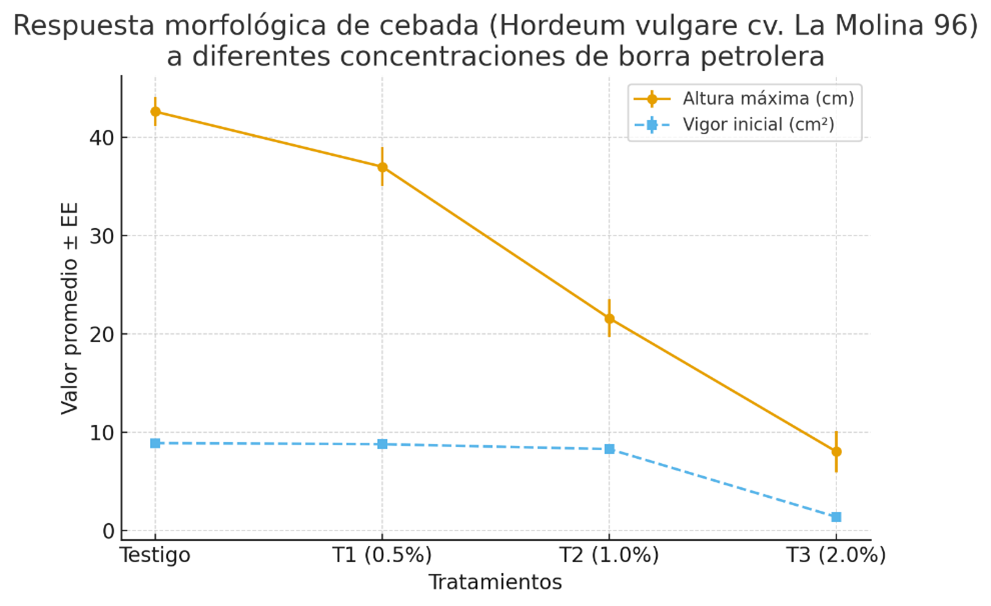
The contamination of agricultural soils with petroleum residues poses a threat to plant development and agroecological productivity. This study aimed to evaluate the morphological response of barley (Hordeum vulgare cv. La Molina 96) and quinoa (Chenopodium quinoa cv. La Molina 89) to different concentrations of petroleum sludge in the soil. A completely randomized design was employeded with six treatments (0 %, 0.5 %, 1 %, 2 %, 4 %, and 6 %) and three replicates per treatment under controlled conditions. Morphophysiological variables including plant height, number of leaves, leaf length, number of grains (in barley), and estimated leaf area were measured. The results showed that both crops failed to germinate from 4% contamination. Barley exhibited reductions of up to 81 % in height, and 84 % in leaf area at 2 % petroleum sludge. Quinoa germinated in all treatments; however, at 2%, its height was reduced by 87% and the number of leaves dropped by 90%. It is concluded that petroleum sludge causes severe phytotoxic effects in both species, with quinoa being relatively more tolerant. These findings suggest its potential use in contaminated soils or as a bioindicator species.
Downloads
References
Abbas, G., Areej, F., Asad, S. A., Saqib, M., Anwar-ul-Haq, M., Afzal, S., Murtaza, B., Amjad, M., Naeem, M. A., Akram, M., Akhtar, N., Aftab, M., & Siddique, K. H. M. (2023). Differential Effect of Heat Stress on Drought and Salt Tolerance Potential of Quinoa Genotypes: A Physiological and Biochemical Investigation. Plants, 12(4), 774. https://doi.org/10.3390/plants12040774
Alharby, H. F., Al-Zahrani, H. S., & Abbas, G. (2022). Potassium and Silicon Synergistically Increase Cadmium and Lead Tolerance and Phytostabilization by Quinoa through Modulation of Physiological and Biochemical Attributes. Toxics, 10(4), 169. https://doi.org/10.3390/toxics10040169
Amjad, M., Iqbal, M. M., Abbas, G., Farooq, A. B. U., Naeem, M. A., Imran, M., Murtaza, B., Nadeem, M., & Jacobsen, S.-E. (2022). Assessment of cadmium and lead tolerance potential of quinoa (Chenopodium quinoa Willd) and its implications for phytoremediation and human health. Environmental Geochemistry and Health, 44(5), 1487–1500. https://doi.org/10.1007/s10653-021-00826-0
Barati, M., Safarzadeh, S., Mowla, D., & Bakhtiari, F. (2020). Effect of Barley and Oat Plants on Phytoremediation of Petroleum Polluted Soils. Pollution, 6(4), 695–703. https://doi.org/https://doi.org/10.22059/poll.2020.297258.746
Chand, P., Dutta, S., & Mukherji, S. (2022). Slurry phase biodegradation of heavy oily sludge and evidence of asphaltene biotransformation. Journal of Environmental Management, 324, 116315. https://doi.org/10.1016/j.jenvman.2022.116315
Haseeb, M., Iqbal, S., Hafeez, M. B., Saddiq, M. S., Zahra, N., Raza, A., Lbrahim, M. U., Iqbal, J., Kamran, M., Ali, Q., Javed, T., Ali, H. M., & Siddiqui, M. H. (2022). Phytoremediation of nickel by quinoa: Morphological and physiological response. PLOS ONE, 17(1), e0262309. https://doi.org/10.1371/journal.pone.0262309
Hinojosa, L., González, J. A., Barrios-Masias, F. H., Fuentes, F., & Murphy, K. M. (2018). Quinoa Abiotic Stress Responses: A Review. Plants, 7(4), 106. https://doi.org/10.3390/plants7040106
Isla Climente, R. (1996). Efecto de la salinidad sobre la cebada (Hordeum vulgare L.). Análisis de caracteres morfo-fisiológicos y su relación con la tolerancia a la salinidad [Universitat de Lleida]. http://hdl.handle.net/10803/8324
Kamranifar, M., Pourzamani, H., Khosravi, R., Ranjbar, G., & Ebrahimpour, K. (2025). Phytotoxic effects of petroleum hydrocarbons on germination and growth of the native halophyte Salicornia sinus persica in oil contaminated soil. Scientific Reports, 15(1), 8459. https://doi.org/10.1038/s41598-025-92512-9
Kashi, M. H., Tabatabaee, M. S., & Soleimani, N. A. (2018). Biodegradation of the Most Heavier Fraction of Crude Oil, Asphaltene, by Bacillus toyonensis BCT-7112. Journal of Chemical Health Risks, 8(1). https://jchr.org/index.php/JCHR/article/view/87
Khalili, P., Hoodaji, M., Nadoushan, M. A., & Chamani, A. (2024). Assessing some Cereals and Quinoa as Bioindicators and Phytoextractors of Heavy Metals in Soils Contaminated with Drill Cutting Waste. Journal of Soil Science and Plant Nutrition, 24(2), 3631–3648. https://doi.org/10.1007/s42729-024-01782-1
Khatibi, S., & Hosseini, H. M. (2018). Assessment of Certain Plant Species degrading Total Petroleum Hydrocarbons in Contaminated Soil. Grassroots Journal of Natural Resources, 1(1), 69–82. https://doi.org/10.33002/nr2581.6853.01017
Korshunova, T. Y., Vysotskaya, L. B., Arkhipova, T. N., Kuzina, E. V., Rafikova, G. F., Chetverikova, D. V., Bakaeva, M. D., & Chetverikov, S. P. (2021). Morphological and physiological-biochemical response of plants to treatment with hydrocarbon bacteria on the background of oil contamination. ÈKOBIOTEH, 4(2), 72–80. https://doi.org/10.31163/2618-964X-2021-4-2-72-80
Liao, Y., Geng, A., & Huang, H. (2009). The influence of biodegradation on resins and asphaltenes in the Liaohe Basin. Organic Geochemistry, 40(3), 312–320. https://doi.org/10.1016/j.orggeochem.2008.12.006
Matías, J., Cruz, V., Rodríguez, M. J., Calvo, P., Maestro-Gaitán, I., & Reguera, M. (2024). Evaluating Yield, Nutritional Quality, and Environmental Impact of Quinoa Straws across Mediterranean Water Environments. Plants, 13(6), 751. https://doi.org/10.3390/plants13060751
Navas-Cáceres, O. D., Parada, M., & Zafra, G. (2023). Development of a highly tolerant bacterial consortium for asphaltene biodegradation in soils. Environmental Science and Pollution Research, 30(59), 123439–123451. https://doi.org/10.1007/s11356-023-30682-7
Nikalje, G. C., & Suprasanna, P. (2018). Coping With Metal Toxicity – Cues From Halophytes. Frontiers in Plant Science, 9. https://doi.org/10.3389/fpls.2018.00777
Pathan, S., Ndunguru, G., Clark, K., & Ayele, A. G. (2023). Yield and nutritional responses of quinoa (Chenopodium quinoa Willd.) genotypes to irrigated, rainfed, and drought-stress environments. Frontiers in Sustainable Food Systems, 7. https://doi.org/10.3389/fsufs.2023.1242187
Rivera-Cruz, M. del C., & Trujillo-Narcía, A. (2004). Estudio de toxicidad vegetal en suelos con petróleos nuevo e intemperizado. Interciencia, 29(7). https://ve.scielo.org/scielo.php?script=sci_arttext&pid=S0378-18442004000700007
Tavassoli, T., Mousavi, S. M., Shojaosadati, S. A., & Salehizadeh, H. (2012). Asphaltene biodegradation using microorganisms isolated from oil samples. Fuel, 93, 142–148. https://doi.org/10.1016/j.fuel.2011.10.021
Downloads
Published
How to Cite
Issue
Section
License
Copyright (c) 2026 Aldo Alberto Cabrera-Berrocal, Ronald Rolando Mori-Pezo, Pedro Mendoza-Tamani

This work is licensed under a Creative Commons Attribution 4.0 International License.
Authors retain their rights:
a. The authors retain the intellectual property rights (copyright) of the published works, assigning to the journal the right of first publication.
b. Authors retain their trademark and patent rights, and also on any process or procedure described in the article.
c. Authors retain the right to share, copy, distribute, perform and publicly communicate the article published in REPIA (e.g., place it in an institutional repository or publish it in a book), with an acknowledgement of its initial publication in REPIA.
d. Authors retain the right to make a subsequent publication of their work, to use the article or any part of it (e.g., a compilation of their work, notes for conferences, theses, or for a book), provided they indicate the source of publication (authors of the work, journal, volume, number, and date).